
Flowers are Blooming

In this week’s edition of The Indian Radius, we unpack PM Modi’s visit to Seychelles and Japanese Prime Minister Sanae Takaichi’s maiden visit to India.
We often talk about India’s role as a regional security provider, but we do not explore some of its earliest instances. Indian interventions in Mauritius and Sri Lanka are relatively well-known, but there is one story that remains discreet.
It was in June 1976 that Seychelles became independent from Britain. With the backdrop of the Cold War, the African nation, located between Madagascar and the Persian Gulf, attracted the attention of both superpowers. The United States was already operating a satellite-tracking station, but was also exploring the establishment of a military base to reduce dependence on Diego Garcia. Meanwhile, the Soviet Union sought to remove the American presence and secure its own access.
Under President France-Albert René, Seychelles became an unusually skilful, if authoritarian, small state that extracted security, aid and diplomatic space from competing partners. It accommodated both American and Soviet demands, publicly opposed apartheid South Africa, and eventually turned to India when René feared that his own government might be overthrown.
In 1986, an Indian frigate arrived in Seychelles for what appeared to be a routine Independence Day visit. It then reported an engineering fault and remained in Port Victoria for nearly two weeks. But this was a ruse. India had received information about a possible coup against President René, and the ship’s extended stay was intended to warn the plotters that New Delhi might intervene. There were no shots fired, and no Indian occupation followed. Thus, this episode, codenamed Operation Flowers Are Blooming, became an early demonstration of India’s emerging role as a security provider in the Indian Ocean.
Beyond the Blue Horizon
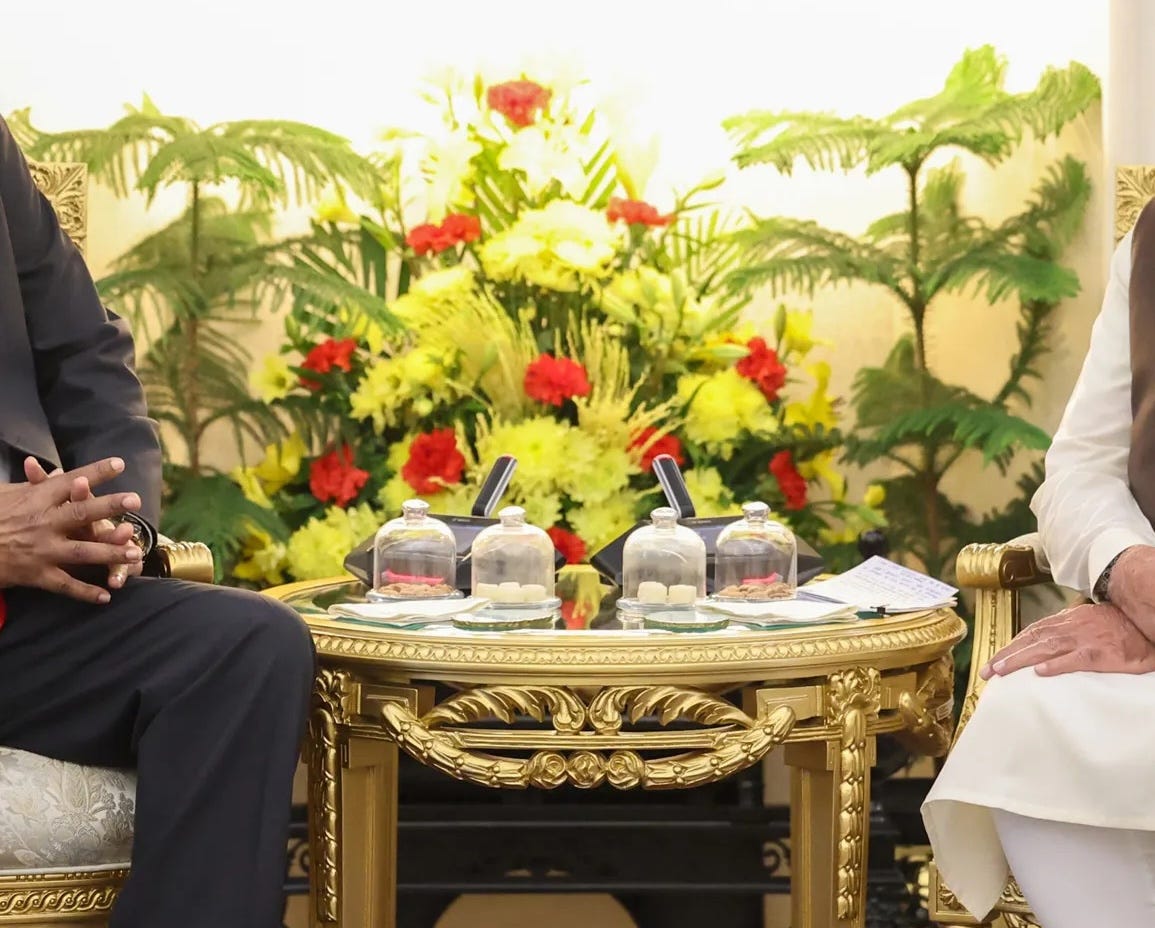
This week, Prime Minister Narendra Modi undertook a state visit to Mahé, attending the country’s Golden Jubilee independence celebrations as the guest of honour. The visit also marked fifty years of India–Seychelles diplomatic relations and was Modi’s first trip to Seychelles since 2015.
President Herminie conferred the newly established “Guardian of the Blue Horizon” distinction on the Indian leader, citing his work on climate action, the blue economy, ocean resource management, and the interests of Small Island Developing States. PM Modi became the first recipient of the distinction.
Earlier this year, President Patrick Herminie’s visit to India produced the broader India–Seychelles Joint Vision and a $175 million economic package. Modi’s return visit converted parts of that framework into financial agreements, defence assets and sector-specific cooperation.
The $175 million Special Economic Package for Seychelles consists of a $125 million rupee-denominated Line of Credit and a $50 million grant. This assistance funds infrastructure in social housing, e-mobility, health, and vocational training, alongside defence and maritime security support.
There were 19 outcomes consisting of:
Nine agreements or memoranda of understanding
Five development-assistance handovers
Five additional project announcements
The handovers included an Indian-built fast patrol vessel, PS Lespwar, to the Seychelles Coast Guard, along with 10 utility vehicles and 5 sets of Laser Radial class boats to the Seychelles Defence Force. The completion of the Refit of PS Zoroaster for the Seychelles Coast Guard and the upgradation of a Dornier Aircraft were also announced.
Indian naval vessels INS Tarkash and INS Ikshak participated in the independence celebrations, continuing a tradition of Indian military participation in Seychelles’ National Day ceremonies. The visit strengthened India’s role as Seychelles’ maritime security partner while expanding the relationship into digital payments, healthcare, vocational education, space cooperation, agriculture, and climate resilience.
More importantly, it reflected a recalibration of India’s Indian Ocean policy. Instead of relying on a controversial search for strategic facilities, India is building influence through a network of locally owned assets, delivery of public goods and institutional partnerships.
Another Blossoming
Although spring has passed on the calendar, a new season appears to be dawning in the India–Japan relationship.
Japanese Prime Minister Sanae Takaichi is in New Delhi for the 16th India–Japan Annual Summit. Here are some of the key outcomes:
The two countries reached an agreement on their first defence co-development project, involving the naval radio antenna system, UNICORN. (This was previously covered in the August 2024 edition of the Indian Radius)
The two sides issued a joint statement on artificial intelligence, complemented by agreements between Indian AI institutions and Japanese partners.
The leaders issued a statement on energy resilience, aimed partly at improving their capacity to manage external supply disruptions and oil-price shocks.
A Memorandum of Cooperation on the India–Japan Biogas Initiative was signed to support the development of 1,000 biogas and organic fertiliser plants in India.
PM Modi cited more than 100 business agreements over the preceding year, expected to generate over $10 billion in Japanese investment in India. He reaffirmed the longer-term objective of securing ¥10 trillion in Japanese investment over ten years and doubling the number of Japanese companies operating in India.
To understand the broader trajectory of Japan’s security outlook, read The Takshashila Institution’s latest paper on the Journey of Japan’s Defence Transformation.
Thank you for reading this edition of the Indian Radius.